
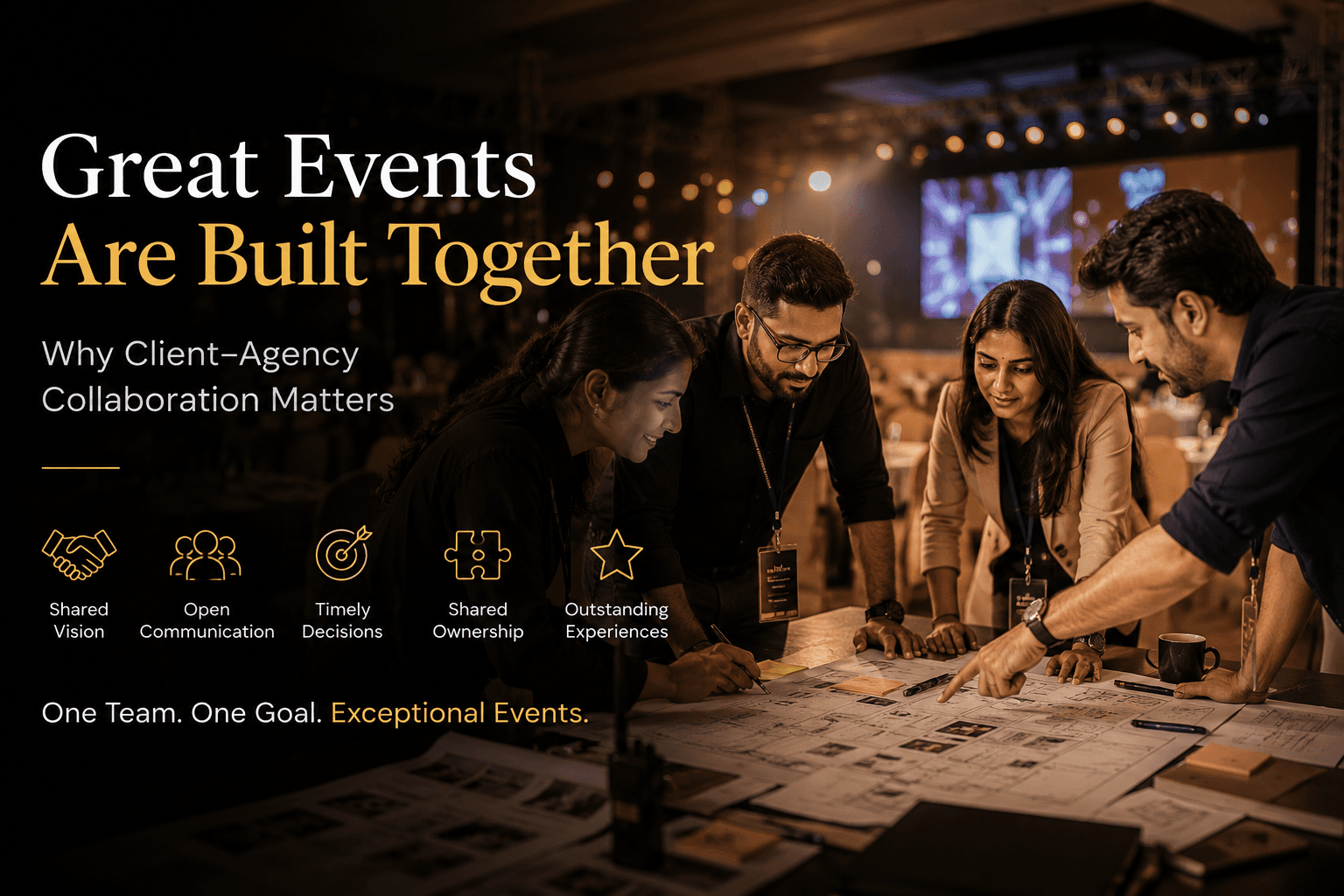
When guests walk into a successful event, they see the final experience.
The stage. The branding. The content. The hospitality. The entertainment.
What they don't see are the hundreds of conversations and decisions that made it possible.
And behind most successful events, there is something more important than production, technology or décor:
A strong partnership between the client and the event agency.
After years of working on events, I have come to believe that the quality of this partnership often has as much impact on the final outcome as the quality of the creative idea.
The Client Knows the Brand. The Agency Knows the Ground.
The client understands the business.
The audience, internal stakeholders, brand sensitivities, objectives and what the event ultimately needs to achieve.
The agency brings another kind of expertise.
Venues. Production. Fabrication. AV. Logistics. Manpower. Guest movement. Timelines. Permissions. And the realities of making an idea work on the ground.
Neither perspective is enough by itself.
The strongest events happen when these two kinds of expertise come together early.
Start With the Objective
Before discussing stages, themes or entertainment, answer one question:
Why are we doing this event?
Is it a product launch?
A dealer meet?
An employee event?
A leadership conference?
A celebration?
A customer experience?
The answer should influence almost every subsequent decision.
A good agency therefore needs more than a list of deliverables. It needs context.
When we understand why something needs to happen, we can usually make much better recommendations about how it should happen.
Be Open About Budgets and Constraints
Some of the most productive client conversations happen when everyone puts the reality on the table early.
The budget.
The timeline.
The non-negotiables.
The internal approval process.
The venue limitations.
The agency can then decide where money will create the greatest impact and where smarter alternatives are possible.
Budget transparency doesn't necessarily mean spending more.
Often, it means spending better.
The same applies to timelines.
If an approval is delayed, the agency should explain the consequence.
If a late change increases cost, the client should know before work begins.
If something cannot be executed safely or properly within the available time, the agency should be comfortable saying so.
Good partnerships need honest conversations.
Timely Decisions Matter
Events work backwards from a deadline that cannot move.
At some point, the doors will open and the guests will arrive.
A delayed artwork approval may delay printing.
Printing can delay fabrication.
Fabrication can delay dispatch.
That can reduce installation and testing time.
Suddenly, what looked like a small approval delay has become an event-day problem.
This is why a strong agency must make dependencies clear—and a strong client must understand why certain decisions need to be made on time.
An approval isn't just an email. It often allows several other teams to start working.
Trust the Expertise You Have Hired
There will be moments when an agency needs to say:
The setup time is too short.
The venue may not permit this.
This will create congestion.
This change will affect production quality.
There is a better place to spend this money.
We need a backup plan.
A responsible agency cannot simply say yes to everything.
Its job is to help the client understand the consequences of a decision.
Equally, agencies must recognise that clients have business realities and internal considerations that may not always be visible to us.
Collaboration requires respect in both directions.
And disagreement isn't necessarily bad.
Some of the best solutions emerge when a client challenges the agency, the agency challenges the brief, and everyone remains focused on one question:
What is best for the event and its audience?
When Things Go Wrong, Partnership Really Matters
It is easy to collaborate when everything is going according to plan.
The real test comes when it isn't.
A truck gets delayed.
A speaker is late.
The venue changes something.
Weather intervenes.
Technology fails.
A requirement changes at the last minute.
At that moment, there are two questions teams can ask.
“Whose fault is this?”
or
“What do we do now?”
The second question saves events.
When trust already exists, people stop protecting their individual positions and start protecting the outcome.
In my experience, some of the strongest client–agency relationships are built not during the easiest events, but during the difficult ones.
Collaboration Goes Beyond the Client and Agency
An event is ultimately delivered by a much larger team.
Designers.
Fabricators.
Technicians.
Carpenters.
Electricians.
Drivers.
Promoters.
Hospitality teams.
Venue personnel.
Security.
Housekeeping.
Everyone contributes to what the guest eventually experiences.
Clear briefs, realistic timelines, timely payments and respectful communication matter at every level.
When people feel they are part of the outcome rather than simply completing a task, ownership changes.
And so does execution.
The Best Events Have Shared Ownership
The old model of event management looks something like this:
Client briefs → Agency executes → Client evaluates
Great events rarely work that way.
They look more like:
Client expertise + Agency expertise + Shared decisions + Trust = Better execution
The client owns the business objective.
The agency owns execution discipline.
But both own the outcome.
That distinction is important.
Because when everyone protects only their individual deliverable, they optimise their own part.
When everyone protects the event, they optimise the entire experience.
Final Thought
When an event goes well, guests rarely know how complicated it was to create.
That's exactly how it should be.
They don't see the late-night production discussions.
The revised artwork.
The vendor coordination.
The difficult decisions.
The backup plans.
They simply experience an event that feels effortless.
There is a tendency in our industry to ask:
“Which agency executed this event?”
Perhaps the better question is:
“Which team created it?”
Because the best events are not created by an agency alone.
Nor by a client alone.
They happen when the client and agency stop behaving like two sides of a transaction and start behaving like one team with one outcome to protect.
That's when collaboration becomes one of the most important parts of event execution.
Planning an Event With Multiple Stakeholders?
Triangular Dots works with brand, marketing, HR and corporate teams to turn shared objectives into well-planned, smoothly executed events.
Discuss Your Event