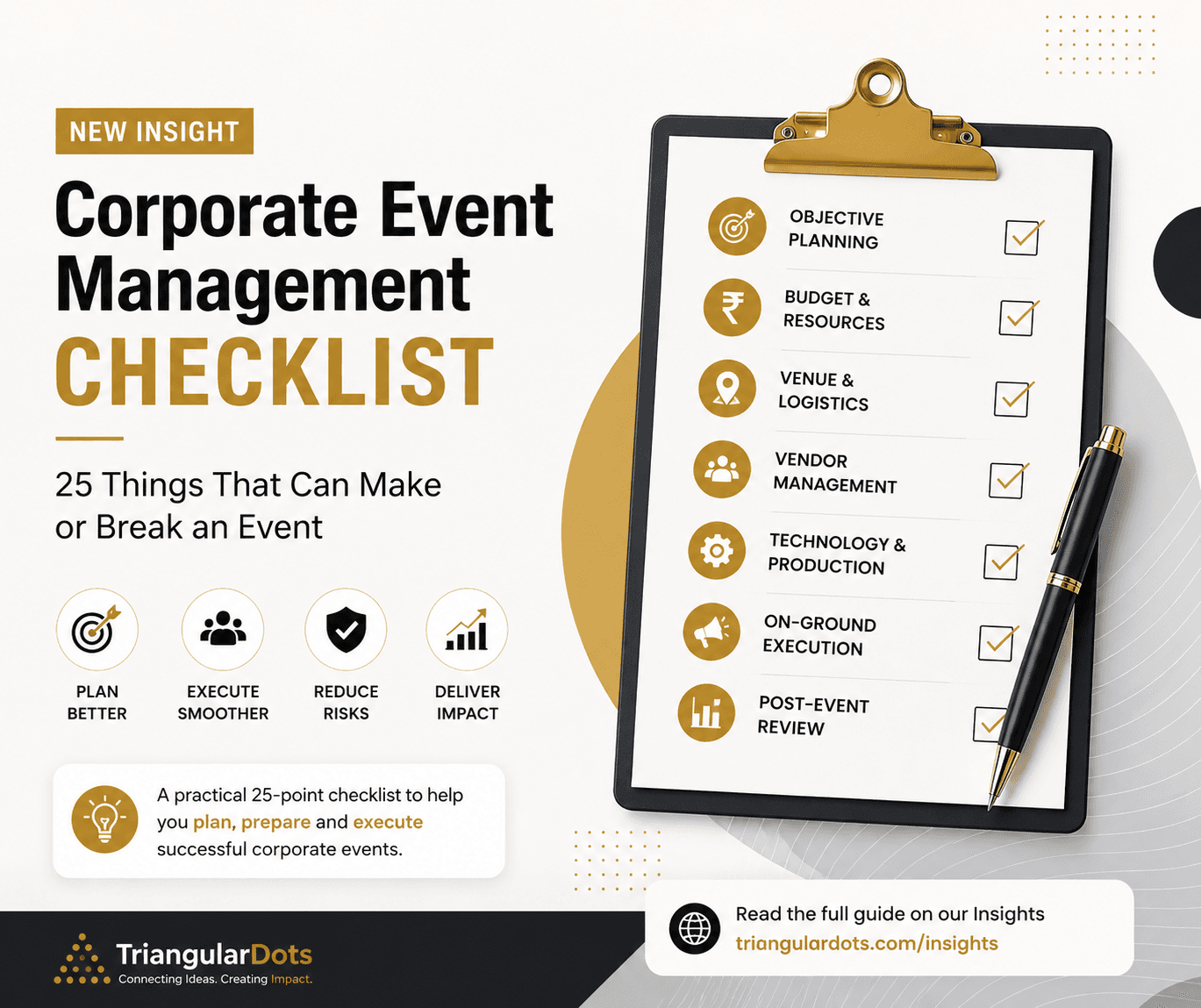
Use this 25-point checklist as a working framework for corporate event management. These are the tasks that usually determine whether an event feels seamless or stressful.
1. Define the business objective
Start by agreeing on why the event exists. Is it meant to launch a product, engage channel partners, strengthen employee alignment, generate leads, or build brand recall? Every planning decision becomes easier once the outcome is clear.
2. Define the audience clearly
A leadership offsite, media launch, dealer meet, and employee town hall all require different experiences. Guest profile affects venue size, format, hospitality, registration flow, language, stage energy, and production design.
3. Fix success metrics early
Do not wait until after the event to decide what success looks like. Track attendance quality, lead volume, partner participation, session engagement, media pickup, social coverage, or post-event feedback before planning moves too far ahead.
4. Lock a realistic budget range
Budget planning must include venue, production, fabrication, branding, manpower, hospitality, gifting, travel, permissions, transport, contingency, and taxes. If a budget only covers visible items, overruns become almost guaranteed.
5. Separate essential spend from optional spend
This is one of the smartest event management checklist habits. Mark what is non-negotiable and what can be trimmed if needed. It protects the event when commercial pressure increases late in the process.
6. Shortlist venues against operational reality
A beautiful venue is not always the right venue. Check load-in access, rigging policies, power availability, backstage space, parking, guest movement, holding areas, washrooms, and local restrictions before confirming anything.
7. Visit the venue physically
Never rely only on photos or PDFs. A physical recce reveals sightline issues, ceiling limits, truck access problems, poor registration space, and hidden practical challenges that directly affect event execution.
8. Confirm venue contracts in detail
Review usage hours, overtime clauses, security deposits, cancellation terms, vendor access rules, branding restrictions, and in-house exclusivity terms. Many production issues begin because commercial terms were not checked carefully.
9. Freeze the vendor list early
Corporate event planning becomes unstable when production, AV, fabrication, hospitality, printing, transport, gifting, and manpower vendors are onboarded too late. Early onboarding improves accountability and sequencing.
10. Define vendor ownership clearly
Every vendor should know scope, reporting contacts, deliverables, arrival time, handover expectation, billing process, and escalation path. Good vendor management is not just commercial; it is operational clarity.
11. Lock brand guidelines and approvals
Branding delays can disrupt stage production, print output, collateral, signages, and digital screens. Freeze logos, messaging, artwork owners, approval sequence, and file deadlines before fabrication begins.
12. Review every branded touchpoint
Stage backdrops, standees, entrance units, podium branding, registration desk, name badges, LED content, print kits, gifting, and wayfinding must all speak the same visual language. Brand inconsistency is highly visible at corporate events.
13. Plan registration and entry flow
Registration planning is not just about check-in desks. It includes guest segmentation, QR or badge process, VIP routing, queue design, support staff, counters per volume, and on-site troubleshooting for walk-ins or list issues.
14. Build the guest communication flow
Invites, reminders, maps, arrival instructions, parking notes, contact numbers, and post-registration confirmations all reduce confusion. A well-informed guest is easier to host and less likely to create pressure at the venue.
15. Map audio visual requirements in detail
AV planning must include screen size, speaker coverage, microphones, clickers, confidence monitors, cue lights, internet requirement, playback formats, livestream needs, and backup devices. Assumptions are dangerous here.
16. Align stage production with the show flow
Stage design, speaker entry, award handovers, presentation cues, lighting shifts, and video playback must all match the run of show. Production timelines fail when design and programming happen in isolation.
17. Create a minute-by-minute production timeline
A real corporate event planning timeline should cover fabrication, printing, truck movement, venue access, load-in, setup, testing, housekeeping, rehearsals, show call, guest arrival, and dismantle. Broad timelines are not enough.
18. Track logistics as a separate workstream
Logistics management includes dispatches, transport sequencing, material labeling, receiving, storage, installation order, and return planning. Without control here, teams waste hours searching for critical materials on-site.
19. Confirm permissions and compliance
Permissions may include venue NOCs, sound rules, local authority approvals, fire norms, exhibitor rules, staffing documentation, or insurance. Event management services in India often succeed or fail on how early compliance is handled.
20. Plan security and crowd movement
Security planning is not only for large public events. Corporate events also need guest screening, VIP movement, backstage access control, emergency exits, baggage handling, and support for high-value equipment or sensitive attendees.
21. Build manpower plans by zone
Do not assign manpower in general terms. Break it into registration, guest assistance, backstage, stage runners, hospitality, technical support, speaker handling, transport desk, and troubleshooting supervisors.
22. Run rehearsals that mirror the live event
Rehearsals should test timing, transitions, presenter movement, mic handovers, video cues, awards sequence, lighting changes, and stage holding positions. If it is not rehearsed, it is not truly ready.
23. Prepare contingency plans for critical risks
Have backups for power, internet, playback devices, microphones, transport delays, weather impact, presenter absence, printing errors, and staffing gaps. Contingency planning is one of the clearest signs of a serious event execution company.
24. Establish on-ground command and escalation
Event day should have one central command structure. Everyone must know who is leading venue operations, client servicing, stage management, technical control, guest experience, and vendor escalation at any given moment.
25. Close with a post-event review
A proper post-event review should cover attendance quality, timeline adherence, vendor performance, budget variance, guest feedback, visual documentation, and lessons for the next event. That is how event management improves over time.