
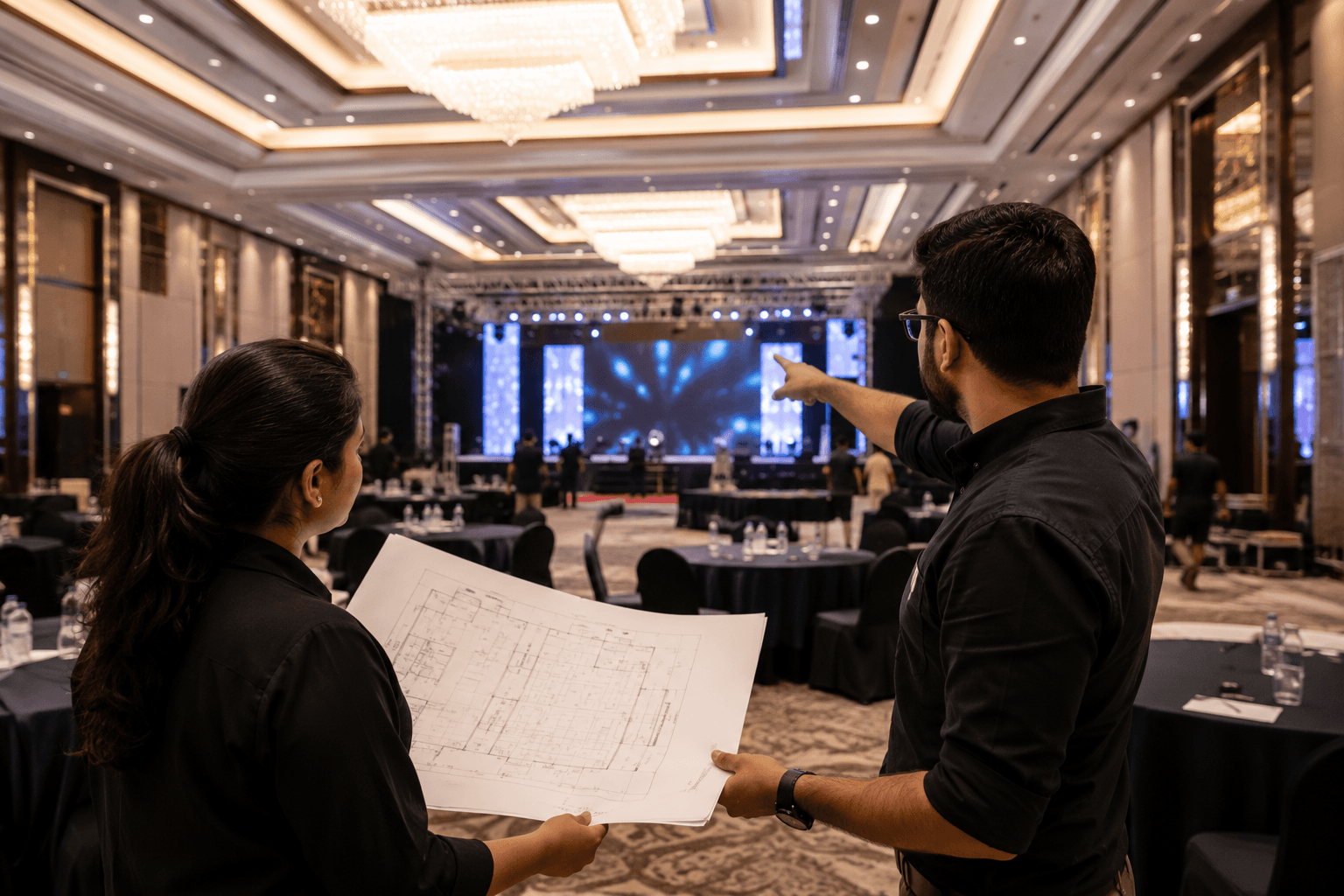
A venue can look perfect in a presentation.
- Beautiful ballroom.
- Great location.
- Enough capacity.
- Premium hotel.
- Impressive photographs.
The client likes it. The dates are available. The commercials work. It feels like the venue decision is almost done. Then the event team visits the property.
And starts asking completely different questions.
Where will the fabrication truck enter?
How large is the service lift?
What time can material come in?
Can the LED structure actually enter the ballroom?
Where will registration happen when 300 guests arrive together?
Where will the speakers wait before going on stage?
What happens if it rains during unloading?
Suddenly, choosing a venue looks very different. After years of executing events, one lesson remains remarkably consistent:
A venue should never be evaluated only for how the event will look when it is ready. It must also be evaluated for everything required to make the event ready.
Photographs Show the Venue. A Recce Shows the Reality.
Venue photographs are designed to show a property at its best. And they are useful. They help us understand aesthetics, approximate scale and the overall character of the space.
But photographs rarely show the service entrance. The loading bay. The freight lift.
The backstage corridor. The electrical points. The storage areas.
The route from the truck to the ballroom. Or the space where fifty people may suddenly gather outside registration. These are not glamorous parts of an event.
But they can determine whether execution is smooth or chaotic. A ballroom may comfortably seat 500 guests and still be extremely difficult to produce an event inside. That is why a recce is not simply a venue visit.
It is an execution test.
Start Outside the Ballroom
One of the first things an event team should understand is how everything reaches the venue.
- Fabrication.
- LED panels.
- AV equipment.
- Branding.
- Furniture.
- Registration material.
- Gifts.
- Technical cases.
Sometimes the biggest execution challenge is not inside the ballroom at all. It is getting everything there. Can a large truck reach the loading area?
What are the loading and unloading timings? Is material movement allowed through guest areas? Is there a freight elevator?
What are its dimensions? Are there stairs, narrow passages or sharp turns between the loading bay and the event space? Are there restrictions on overnight movement?
If the venue is inside a hotel or mall, what other operations share the same service access? A beautiful stage design becomes irrelevant if its largest component cannot physically reach the ballroom.
Look Up, Not Just Around
Ballroom size is only one dimension. The ceiling can completely change what is possible. An experienced production team will look at:
- Clear ceiling height
- Chandeliers
- Existing lighting fixtures
- Rigging points
- Sprinklers
- Smoke detectors
- Air-conditioning vents
- Projectors
- Structural restrictions
A render may show an impressive LED wall, suspended branding or lighting truss. The venue may have very different ideas. This is why creative design and production reality should meet before the design is frozen.
It is far cheaper to change something on a screen than after fabrication has begun.
Walk the Event Like a Guest
A recce should not only be technical. At some point, stop thinking like the production team and start walking through the venue like a guest. Where do I arrive?
Where do I park? Where do I enter? Can I immediately understand where the event is?
Where is registration? What happens if several hundred guests arrive within twenty minutes? Where do queues form?
After registration, where do guests naturally move? Where are the washrooms? Where is the ballroom entrance?
Where will refreshments be served? Where do VIPs enter? A venue may have sufficient capacity but poor guest flow.
And poor flow becomes visible very quickly. The first experience of an event is often not the stage.
It is the arrival.
Backstage Is Part of the Stage
The audience sees what happens on stage. The event team needs to understand what happens behind it. Where will speakers wait?
Where will artists prepare? Where will awards or trophies be kept? Where does the stage manager operate?
Where do laptops and playback systems sit? Can people move from backstage to stage without walking through the audience? Is there enough room for equipment cases and technical crew?
Backstage space is frequently sacrificed because it generates no photographs. But during a live event, it becomes one of the most important operational areas in the venue. A calm stage usually has a well-organised backstage behind it.
Understand What the Venue Will and Will Not Allow
Every venue has rules. Some permit fabrication inside. Others allow only assembly.
Some have strict sound limits. Some insist on approved electrical vendors. Some restrict drilling, painting or adhesive application.
Some have specific fire-retardant requirements. Some have hard cut-off times for setup and dismantling. Some charge overtime once the agreed access window is exceeded.
These details affect more than execution.
They affect the budget.
A venue that initially appears commercially attractive can become expensive if the event plan requires additional labour, overnight setup, restricted vendor usage or extended possession. The recce should therefore connect the creative plan, production plan and commercial plan.
Check Power Before You Need It
Modern corporate events consume significant power.
- LED walls.
- Lighting.
- Audio.
- Laptops.
- Charging stations.
- Product demonstrations.
- Broadcast equipment.
- Registration systems.
- Hospitality equipment.
Do not assume the venue has enough power simply because it regularly hosts events. Understand what is available. Where it is available.
What needs to be ordered separately. And what the backup arrangement is. The time to discover an electrical limitation is during the recce.
Not during the technical rehearsal.
Ask What Else Is Happening That Day
This is one of the simplest questions—and one of the most useful.
What other events are happening at the venue on the same day?
Another ballroom may have a wedding. A conference may be dismantling while your material is arriving. Two events may share the loading bay.
Another organiser may be using the same foyer. Guest parking may be under pressure. The hotel may have restrictions because of a VIP movement.
A venue does not operate in isolation simply because your ballroom is booked. Understanding the property's complete operating environment can prevent surprises later.
Weather Matters Even for Indoor Events
An indoor event can still have an outdoor logistics problem. Mumbai makes this particularly obvious during the monsoon. Where will guests alight if it rains?
Is registration protected? Can fabrication material be unloaded under cover? What happens to the queue outside the ballroom?
Is there a protected route from parking to the venue? Can trucks wait nearby if unloading is temporarily stopped? Weather planning should not begin when the forecast changes.
It should begin during the recce.
The Recce Should End With Decisions
A good site visit should not finish with hundreds of photographs sitting inside someone's phone. It should produce decisions. After the recce, the team should know:
- Final usable event space
- Stage orientation
- LED and AV feasibility
- Registration location
- Guest movement
- VIP movement
- Backstage requirements
- Loading and unloading plan
- Electrical requirements
- Branding opportunities
- Venue restrictions
- Setup and dismantling windows
- Storage requirements
- Safety considerations
- Key contingencies
And importantly:
Who owns each unresolved point?
A recce without documentation becomes a memory exercise. A recce with clear actions becomes part of the production plan.
Final Thought
Clients and event agencies often look at the same venue through different lenses. The client may see a beautiful ballroom and imagine the event. The creative team may see possibilities.
The production team sees dimensions, access and infrastructure. The guest-management team sees arrival and movement. The technical team sees power, rigging and connectivity.
None of these perspectives is more important than the others. They need to come together. Because a successful venue is not simply somewhere an event fits.
It is somewhere the event can be built, operated and experienced properly. There is one question I believe every event team should ask before finally approving a venue:
“Can we execute here as well as we can imagine here?”
If the answer is yes, you probably have the right venue. And if the answer is uncertain, another site visit may save you a very expensive lesson later.

Gaurav writes about leadership, operational excellence, exhibitions, experiential marketing and event execution through practical observations from the field.
Planning a Corporate Event?
Triangular Dots helps brands evaluate venues, plan production, coordinate logistics and manage on-ground execution from recce to final handover.
Discuss Your Event