
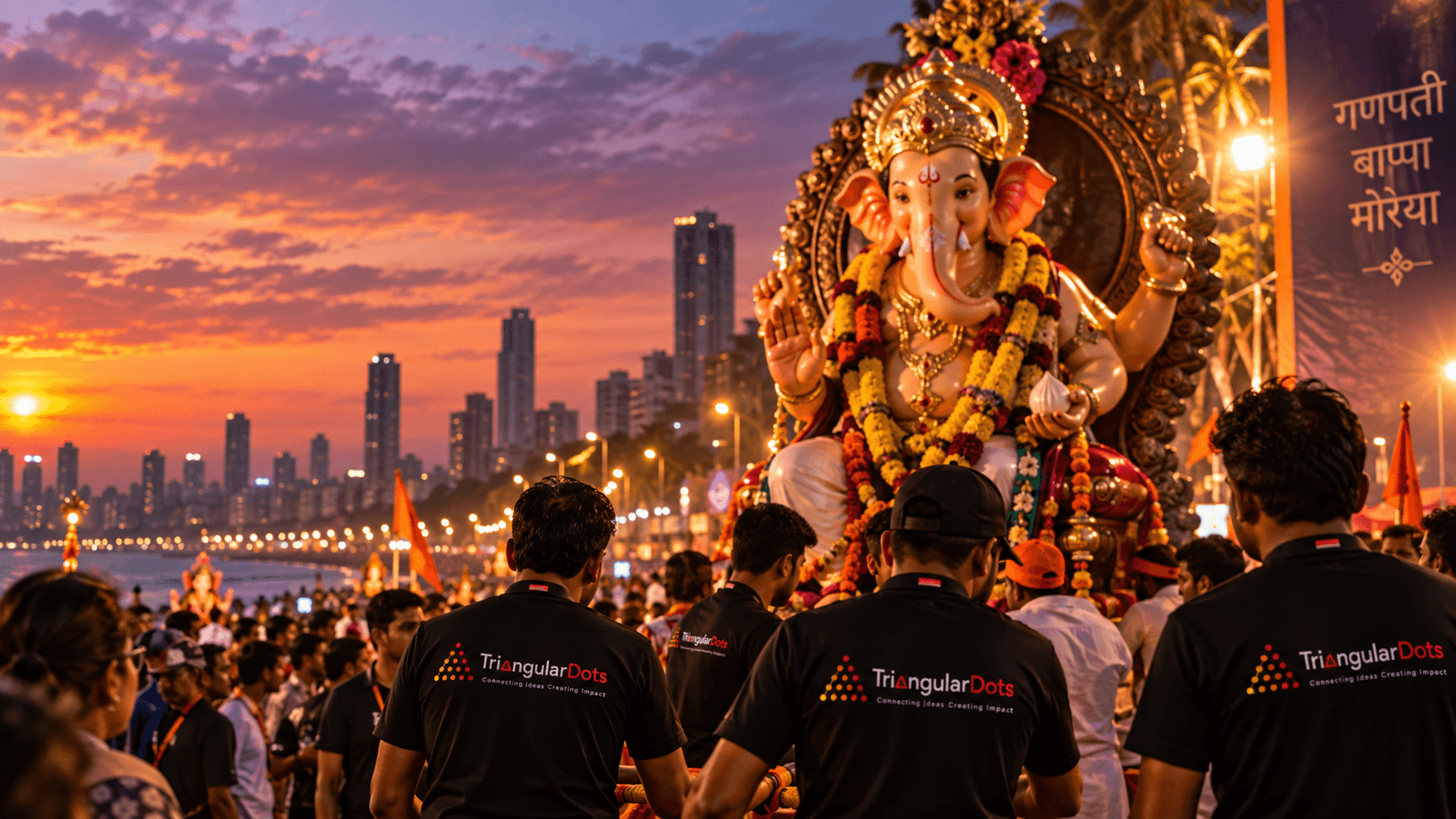
Every year during Ganesh Chaturthi, Mumbai witnesses something extraordinary. Beautiful pandals come alive. Crowds move through them. Volunteers manage queues. Artisans complete installations. Lighting and sound teams work behind the scenes. Security teams manage movement. Vendors keep supplies flowing. Authorities coordinate traffic and safety. And eventually, communities come together for visarjan. To a visitor, it is an experience rooted in faith, tradition and celebration. To someone from the events industry, there is also a remarkable lesson in coordination.
Because nothing of this scale can be managed by one person or one team. It works because many different people understand that they are contributing to the same outcome. And that is remarkably similar to what makes a corporate event successful.
A Great Event Is Never the Work of One Team
When guests attend a corporate event, they experience one event. Behind it are multiple teams — client, agency, venue, creative, fabrication, AV, lighting, hospitality, registration, transport, security, artists, housekeeping and vendors — each responsible for a different part of the execution. But the guest should never experience those responsibilities separately. They should experience one seamless event.
Ganesh Chaturthi demonstrates this beautifully. The person managing a queue may have nothing to do with the person managing lighting. The artisan may never interact with the traffic-management team. Yet everyone contributes to the same experience. That is collaboration. Not everyone doing the same job, but everyone doing their own job while understanding the larger objective.
Coordination Begins With Clarity
Large events rarely become chaotic because people are unwilling to work. They become chaotic because responsibilities are unclear. Who owns the stage? Who approves artwork? Who handles the VIP? Who talks to the venue? Who manages registration? Who makes the final decision when something changes? If everyone owns everything, eventually nobody owns anything. Large public celebrations work because responsibilities are distributed. Different people manage entrances, queues, security, logistics, installations and movement. Corporate events need the same discipline.
Timing Connects Everyone
An event is a chain of dependencies. Artwork approval affects printing. Printing affects fabrication. Fabrication affects installation. Installation affects AV testing. AV testing affects rehearsals. One delay can travel through the entire event. This is why coordination is not simply about creating a timeline. It is about understanding who depends on whom.
Ganesh Chaturthi celebrations involve similar dependencies. Installations must be ready before visitors arrive. Routes need planning before movement begins. Volunteers need to be positioned before crowds build. Visarjan requires coordination between communities, authorities, traffic teams and volunteers. The visible moment depends on many invisible timelines coming together.
Collaboration Matters Most When the Plan Changes
No large event goes exactly according to plan. Rain arrives. Traffic builds. A guest is delayed. Equipment develops a problem. A vendor gets stuck. The programme runs longer than expected. The crowd behaves differently from what was anticipated. This is when collaboration stops being a management term and becomes an execution capability. Teams can ask: “Who is responsible for this problem?” Or: “What do we need to do now?” The second question usually saves the event.
Mumbai sees this adaptability repeatedly during Ganesh Chaturthi. Crowds fluctuate, weather changes and traffic patterns shift, yet thousands of people keep adapting around a common purpose. That ability to adjust without losing sight of the larger objective is one of the most valuable skills in event execution.
The Audience Should Never See the Coordination
There is an interesting paradox in events. The more coordination happening behind the scenes, the less the audience should notice it. Guests should not know that a truck arrived late, artwork had to be replaced, a speaker changed their timing or a technical problem was solved five minutes before the show. They should simply feel that everything worked. The same is true when you enter a well-managed Ganesh pandal. You see the decoration, energy and experience. You rarely think about the permissions, logistics, manpower, planning meetings and coordination behind it.
Great execution hides its own complexity.
Respect Every Person in the Chain
Large experiences depend on many people whose names may never appear anywhere. The artisan. The carpenter. The electrician. The driver. The technician. The volunteer. The security guard. The person cleaning the venue. The person carrying material late at night. Corporate events are no different. A spectacular stage means little if the microphone cue is missed. A beautiful registration area fails if the team hasn't been briefed. A premium venue cannot compensate for poor guest movement. Every role matters. Good event leadership is therefore not only about managing senior stakeholders.
It is about creating clarity, respect and ownership across the entire execution chain.
The Event Isn't Over When the Guests Leave
An event does not end when the photographs are taken. Material has to be dismantled. Equipment has to return. Venues need to be handed back. Vendors need closure. Costs need reconciliation. Waste needs to be managed. Teams need to review what worked and what didn't. Ganesh Chaturthi gives us a powerful reminder of this too. The celebration culminates in visarjan, but that itself requires enormous coordination around people, movement, traffic and safety. Good execution plans the exit with the same seriousness as the entry.
Final Thought
Ganesh Chaturthi is, of course, much more than an event. It is faith, tradition, emotion and community. But for those of us who spend our lives planning and executing experiences, it also offers a remarkable lesson in what people can achieve when they work together. Different people. Different responsibilities. Different skills. One shared purpose. Perhaps that is the simplest definition of great event execution too. The client does not succeed alone. The agency does not succeed alone. The venue and vendors do not succeed alone.
The event succeeds when everyone understands that the experience belongs to all of them. Because the biggest events are rarely held together by one great idea. They are held together by coordination, collaboration and collective ownership. And when those three things work well, something incredibly complicated can appear beautifully simple.

Gaurav writes about leadership, operational excellence, exhibitions, experiential marketing and event execution through practical observations from the field.
Planning a Complex Corporate Event?
Triangular Dots works with clients, venues, vendors and execution teams to bring multiple moving parts together into one seamless event experience.
Discuss Your Event