
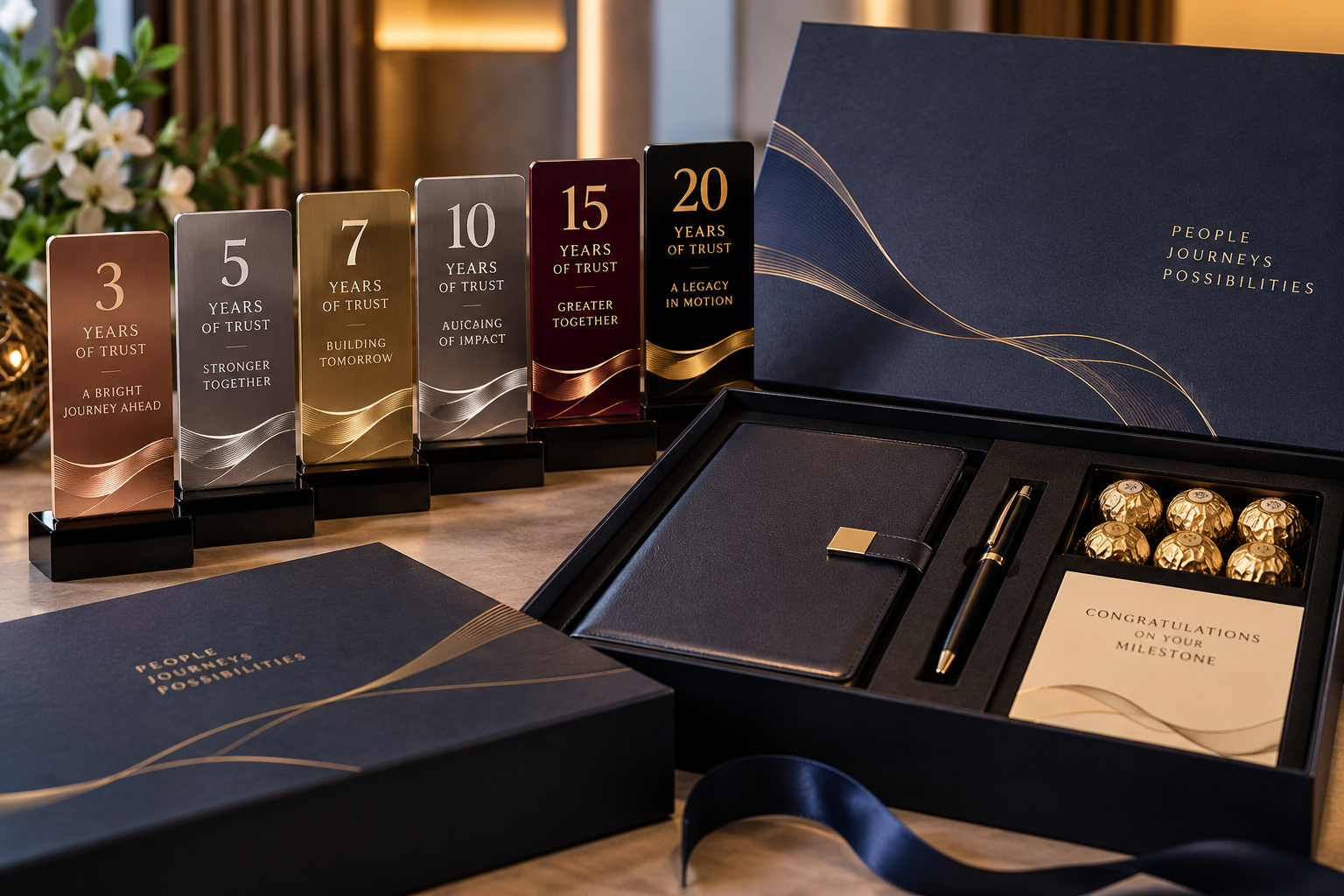
Most corporate gifting conversations begin with a familiar question: “What can we give?” A catalogue opens. Products are shortlisted. Budgets are compared. Logos are added. But I believe there is a better question to ask first: “Why are we giving it?” A gift for an employee completing ten years with the company should not feel like a festive hamper. A gift for an important client should not feel like conference merchandise. And something distributed to 2,000 employees needs to be planned very differently from twenty gifts for senior leadership.
The occasion should define the gift — not the other way around.
1. Employee Recognition: Make It Feel Personal
Recognition gifting should make the employee feel that the organisation noticed the achievement. That doesn't always require an expensive product. Personalisation can often create more impact than price.
- A name.
- A milestone.
- A thoughtful message.
- A beautifully presented certificate.
- A keepsake that connects to the achievement.
The objective is not simply to give the employee something useful. It is to make the recognition feel earned.
2. Long-Service Awards: Create Something Worth Keeping
A three-year milestone and a twenty-year milestone should not feel identical. Long-service gifting needs a sense of progression. The award can evolve through material, finish, packaging, personalisation or the accompanying gift. What matters is that the recipient can look at it years later and immediately understand what it represents. A long-service award should not disappear into a drawer after the ceremony. It should carry the memory of the milestone.
3. Client Gifting: Premium Does Not Mean Excessive
Client gifting requires judgement. Too generic and it feels transactional. Too promotional and it becomes merchandise. Too extravagant and it can become uncomfortable or inappropriate. The strongest client gifts are often restrained, well-made and thoughtfully presented. Something useful. Something distinctive. Something relevant to the relationship. And importantly, something the recipient would actually want to keep.
4. Festive Gifting: Think Beyond the Hamper
Festive gifting often happens at scale, which makes it easy to fall into repetition. Another box. Another selection of sweets. Another dry-fruit hamper. There is nothing wrong with traditional gifting. The opportunity is in how it is curated and presented. A strong festive gift can combine familiar products with something unexpected — a useful object, a personalised element, a regional story or packaging designed specifically for the occasion. The difference is often not the individual products. It is the thought connecting them.
5. Dealer and Channel Gifting: Remember the Relationship
Dealer and channel partners often receive gifts from many brands. That makes another heavily branded object easy to forget. Useful products work well here, but usefulness alone is not enough. Consider:
- How frequently will it be used?
- Where will it sit?
- Will the recipient associate it positively with the brand?
- Does it feel appropriate to the importance of the relationship?
Brand recall is valuable. Brand clutter is not.
6. Event and Conference Gifting: Think About What Happens Next
At an event, the recipient may need to carry the gift for several hours. They may be flying home. They may already have received multiple giveaways. That changes what makes sense. Heavy boxes, fragile products or oversized merchandise can quickly become inconvenient. For event gifting, I would think about:
- Portability.
- Usefulness.
- Packaging.
- Relevance to the event.
- Ease of distribution.
And whether the recipient will still value it after leaving the venue.
7. Leadership and VIP Gifting: Less Can Be More
Senior recipients generally don't need more things. That makes selection harder. Instead of trying to impress through quantity, focus on:
- Quality.
- Craftsmanship.
- Personalisation.
- Provenance.
- Presentation.
A carefully selected single object can feel substantially more premium than a large box filled with unrelated products.
The Box Is Part of the Gift
This is one of the most underestimated parts of corporate gifting. Imagine two gifts containing products of approximately the same value. One arrives in a standard cardboard box. The other arrives in a thoughtfully designed pack with the products arranged properly, a personalised message inside and an unboxing sequence that feels deliberate. They don't feel like the same gift.
This is particularly important when the gifting budget is fixed. Sometimes improving the presentation creates more perceived value than replacing the product with something slightly more expensive.
Personalisation Should Add Meaning, Not Just a Logo
Corporate gifting and corporate branding are not the same thing. Putting a large logo on every object may satisfy a branding requirement, but it can reduce the likelihood that the recipient will actually use the product. There are subtler ways to connect the gift to the organisation:
- A personalised card.
- The recipient's name.
- An engraved message.
- A milestone.
- A custom sleeve.
- A discreet brand element.
- A story inside the box.
The recipient should feel that the gift was created for them — not that they were given advertising material.
Don't Forget the Last Mile
Choosing the gift is only part of a corporate gifting programme. At scale, execution becomes equally important.
- Is the recipient data accurate?
- Is personalisation correct?
- Are all boxes packed consistently?
- Can gifts be delivered across multiple cities?
- What happens if an address is incorrect?
- How are damaged products replaced?
- How will delivery status be tracked?
- Who manages the exceptions?
A beautiful gifting idea can quickly become a poor experience if the execution around it fails. The last mile is part of the gift experience.
Start With Five Questions
Before looking at products, I would answer:
1. Who are we gifting? Employees, clients, partners, leadership or event attendees?
2. Why are we gifting? Recognition, celebration, relationship building, a festival or an event?
3. What should the recipient feel? Recognised? Appreciated? Surprised? Valued?
4. What is the realistic budget? Not just for the product — for packaging, personalisation and delivery as well.
5. What happens after the gift is selected? How many recipients? Where are they? When must everything arrive? Once those answers are clear, choosing the product becomes much easier.
Final Thought
Corporate gifting should not begin with a catalogue. It should begin with an objective. Who are we giving to? Why are we giving? What do we want this gesture to communicate? Then choose the product, packaging, personalisation and delivery around those answers. Because the best corporate gift is not necessarily the one with the highest price tag. It is the one that makes the recipient feel that somebody thought about them before choosing it.

Gaurav writes about leadership, operational excellence, exhibitions, experiential marketing and event execution through practical observations from the field.
Planning a Corporate Gifting Programme?
Share the occasion, number of recipients, budget and delivery requirements with our team.
Explore Corporate Gifting