
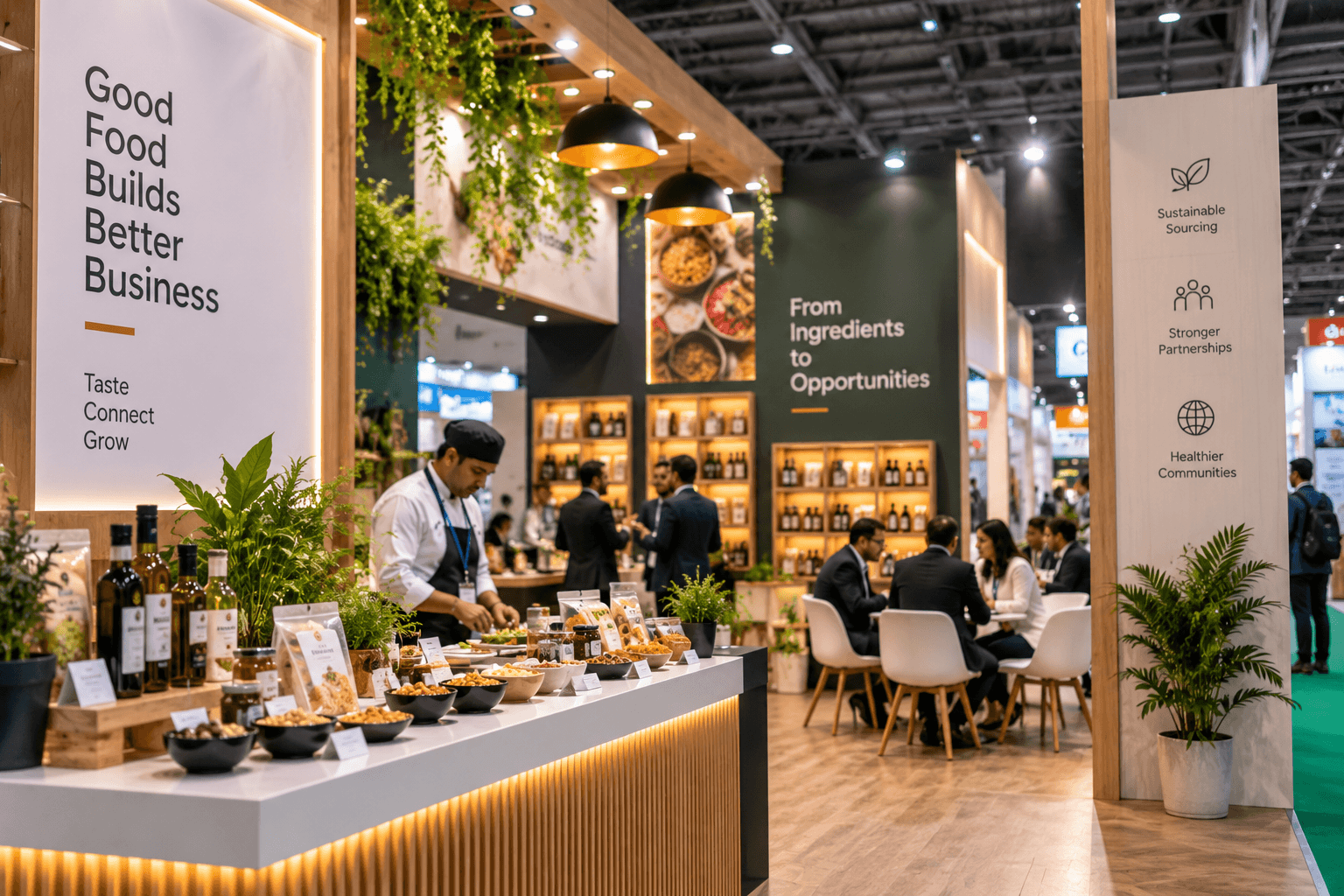
When an exhibitor starts planning a stall, the first conversation often begins with design. What should it look like? What colours should we use? Where should the logo go? Should we have an LED screen? For an exhibition like Indusfood 2027, I believe there is a more important conversation to have first: What does this stall actually need to do? An F&B exhibition stall is not simply a branded space.
It may need to display multiple products, serve samples, store stock, keep products chilled, accommodate buyer meetings, support demonstrations and remain clean and organised throughout a busy exhibition day. If those requirements are understood before design begins, the design becomes much better. Here are the questions I would ask before approving the first layout.
1. What Do You Actually Want From the Exhibition?
Before discussing counters, graphics or lighting, define the business objective. Are you looking for distributors? International buyers? Retail partners? Institutional customers? Product trials? Brand visibility? Meetings with existing customers? Different objectives require different stalls. If serious buyer meetings are important, you need somewhere to have those conversations. If sampling drives the product experience, the sampling area cannot be an afterthought. If you have twenty products but three are strategically important, all twenty should not necessarily receive equal prominence.
The stall layout should follow the business objective — not the other way around.
2. Decide What the Visitor Needs to See First
F&B brands often arrive at exhibitions with a large portfolio. That creates a temptation to display everything everywhere. The result can be a stall full of products but without a clear story. Ask: What are our hero products? What is new? Which products are most relevant to the buyers attending? Which packaging needs physical display? Which products need tasting or demonstration? A visitor walking past the stall should be able to understand who you are and what you sell quickly. Good product visibility is not about displaying the maximum number of SKUs.
It is about creating the right hierarchy.
3. Plan Sampling Before You Approve the Layout
Sampling sounds simple until hundreds of people want to try the product. Where will samples be prepared? Where will they be stored? Who serves them? Where does replenishment come from? Where do used cups, spoons, plates or packaging go? Does the product need heating or cooling? Where does the visitor stand while tasting it? And importantly: Does sampling block the entrance to the stall? A beautifully designed counter can become an operational problem if ten people standing around it prevent everyone else from entering.
4. Storage Is More Important Than It Looks in the Render
Storage rarely gets much attention during the creative presentation. During the exhibition, it becomes extremely important. Think about everything that needs to disappear from the visitor's view: Backup product. Brochures. Giveaways. Packaging. Cleaning material. Staff bags. Water. Stationery. Technical equipment. And for some F&B products, refrigerated stock. Without enough storage, all of this eventually finds its way behind counters, under tables or into meeting areas. By afternoon, the stall looks very different from the morning photographs.
Good exhibition design plans for what visitors should not see as carefully as it plans for what they should see.
5. Give Important Conversations Somewhere to Happen
A busy exhibition aisle is excellent for discovery. It is not always ideal for a serious business conversation. At a B2B exhibition, a promising interaction may quickly move from: “What products do you have?” to: “Can we discuss distribution?” That conversation deserves the right environment. Depending on the stall size, this may mean a small meeting table, a semi-private discussion area or simply seating positioned away from the main visitor flow. The objective is not to create a luxurious lounge. It is to ensure that the stall can support the conversation it was built to generate.
6. Understand Utilities Before Freezing the Design
Some requirements affect the physical design of the stall. Power. Refrigeration. Water, where required. Cooking or preparation equipment. Coffee machines. Display screens. Product demonstrations. Charging. Internet connectivity. These should be identified early. Discovering after fabrication that a refrigerator needs to sit where storage was planned, or that demonstration equipment requires additional power, creates unnecessary compromises. The render should reflect operational reality. Not the other way around.
7. Walk Through the Stall Like a Visitor
Before approving a layout, mentally walk through it. I see the stall from the aisle. What catches my attention? Where do I enter? What do I see first? Where do I discover the products? Where do I sample? If I'm interested, where does the conversation continue? Can I move through the stall without crossing people waiting for samples? Can the brand team move between product display, sampling and meetings comfortably? Sometimes a layout looks excellent from above but doesn't work naturally when people start occupying it. Design for people, not just floor plans.
8. Design for 4 PM, Not Just 9 AM
Most stalls look excellent when the exhibition opens. The real test comes later. Samples have been served. Products have been removed and replaced. Brochures have been picked up. People have moved chairs. Coffee has been served. Packaging has been opened. Staff have been working for hours. Your stall still needs to represent the brand properly. That means planning for: Replenishment. Cleaning. Waste. Storage. Housekeeping. Product resets. Hospitality. A stall should be designed to recover quickly throughout the day.
The visitor arriving at 4 PM deserves the same experience as the visitor who arrived when the doors opened.
9. Don't Approve a Design That Cannot Be Executed Properly
There is always a moment when everyone falls in love with the render. Before approving it, ask the production questions. Can it be fabricated properly? Can the materials reach the venue? Can the structure be installed within the available time? Have electrical and technical requirements been considered? Can the product displays actually carry what is being shown? Is there enough storage? Can branding be replaced if something gets damaged? What happens during dismantling? A good exhibition design should survive the transition from presentation to production to show floor.
If it only works beautifully on a laptop, it isn't finished yet.
Before You Approve Your Indusfood Stall Design
I would make sure the team can answer these ten questions:
- What is the primary business objective?
- Which products need the strongest visibility?
- How will sampling work?
- Where will replenishment stock be stored?
- Is refrigeration required?
- What utilities and technical services are needed?
- Where will serious buyer conversations happen?
- How will visitors move through the stall?
- How will the stall remain clean and replenished throughout the day?
- Has the design been checked for production and installation feasibility?
If those answers are clear, the creative team has a much stronger brief to design against.
Final Thought
Exhibition stall planning often begins with: “What should our stall look like?” For an F&B exhibition, I would begin somewhere else: “What needs to happen inside our stall?” Because once you understand the products, the sampling, the storage, the visitors, the buyers and the conversations you want to create, the design has a purpose. And that is when a stall stops being simply an exhibition structure. It becomes a working business environment.
For brands preparing for Indusfood 2027 at India Expo Center & Mart, Greater Noida, that planning should begin well before fabrication starts. The better the questions at the beginning, the fewer compromises you have to make on the show floor.
Gaurav writes about leadership, operational excellence, exhibitions, experiential marketing and event execution through practical observations from the field.
Planning Your Stall for Indusfood 2027?
Share your booth size, product requirements, sampling needs and brief with our team.
Discuss Your Indusfood Stall