
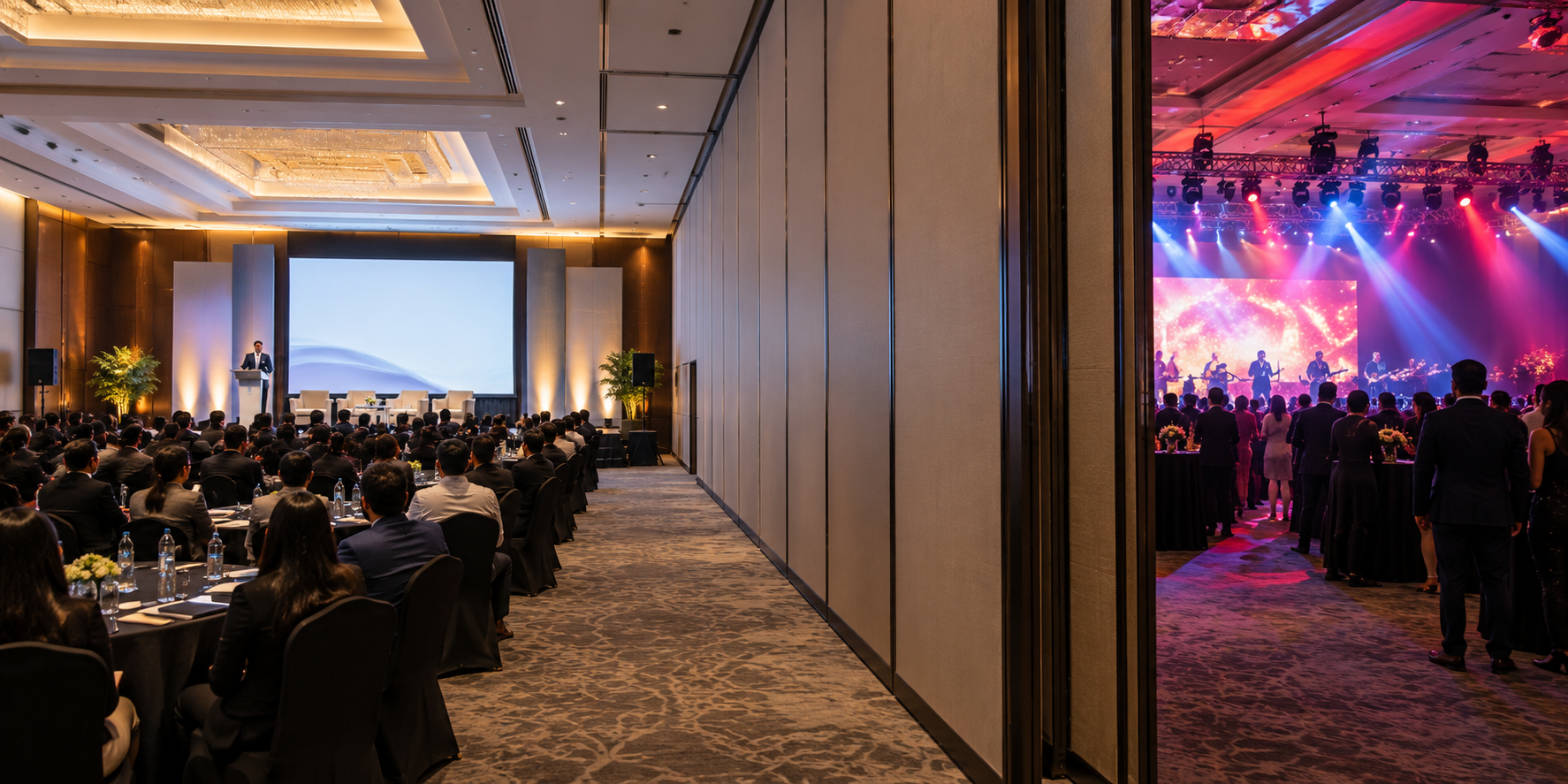
We recently faced an interesting problem at a corporate event. The hotel ballroom had been divided into two halls using a movable partition. Our event was happening on one side. On the other side, another company was conducting a launch. Everything looked perfectly normal when you saw the two spaces independently. Until their music started. The sound travelled through the partition and became clearly audible inside our event. And suddenly, something happening at an entirely different event became our problem too. It reinforced a simple lesson:
When you book part of a divisible ballroom, you are not only booking your space. You also need to understand what could be happening on the other side of the wall.
A Partition Is Not Necessarily a Soundproof Wall
Many hotel ballrooms are designed to be flexible. A large ballroom can become two or three smaller halls using movable acoustic partitions. Operationally, that makes perfect sense. But event teams sometimes assume that because they cannot see the adjoining event, they will not hear it either. That assumption can be expensive. Music, bass, applause, microphones and high-energy AV can travel very differently from normal conversation. The adjoining hall may be perfectly suitable for a conference happening next to another conference.
Put a product launch, awards night or entertainment programme next door and the situation can change completely.
Ask What's Happening Next Door
This is now a question I would add to every relevant venue recce: “What is booked in the adjoining ballroom on our event date?” Not simply: “Is the other hall occupied?” There is a big difference between a board meeting next door and a launch with music, performances and a large sound system. Ask the hotel:
- What type of event is it?
- What are its timings?
- Will they have entertainment?
- Are they using amplified music?
- Where will their stage and speakers be positioned?
- Does their event overlap with our most important sessions?
That information can influence your own room selection and programme.
Test the Partition, Not Just the AV
During a technical recce we normally check our own sound.
- Speaker positions.
- Microphones.
- AV control.
- Stage orientation.
- Acoustics.
But in a divided ballroom, another test matters: What can we hear from the adjoining hall? If possible, ask the venue about previous simultaneous events in those spaces. Walk to both sides of the partition. Understand where the adjoining stage is likely to be. And if your event contains an important leadership address, presentation or discussion, consider what happens if heavy music begins next door at exactly that moment.
Your Stage Position Can Matter
Sometimes the risk can be reduced through planning. If both events place their stages and major speaker systems against the same partition, the problem may be very different from a layout where sound sources are positioned away from the dividing wall. Where possible, understand both room layouts. Your own stage orientation, speaker placement and seating plan may help reduce disruption. The venue and AV teams should be part of that conversation early.
Timings Matter Too
Two events can coexist perfectly for most of the day and conflict for twenty minutes. Unfortunately, those twenty minutes could be the CEO's address. If the adjoining event has a performance scheduled from 7:00 to 7:30 PM and your leadership session begins at 7:00 PM, knowing that beforehand gives you options. A small programme adjustment may solve a problem that no amount of frantic coordination can fix once both events are running. This is why event planning isn't only about your own run-of-show. Sometimes you need to understand the run-of-show next door.
The Hotel, Client and Agency Need to Work Together
This isn't about blaming the venue. Hotels have multiple ballrooms because they are designed to host multiple events. The client may not know what technical questions to ask. And the event agency cannot control an adjoining event it knows nothing about. The solution is collaboration. The hotel needs to share relevant operational information. The agency needs to ask the right questions. And the client needs to understand when a seemingly small venue issue creates a genuine event risk. Good execution often comes down to identifying these dependencies early enough for everyone to act.
Add One Question to Your Next Venue Recce
When viewing a divided ballroom, don't only ask: “How many guests can this hall accommodate?” Also ask: “What is happening on the other side of this partition when our event is live?” It sounds like a small detail. Until the keynote begins and you can hear somebody else's launch music through the wall. Then it becomes one of the most important questions you wish somebody had asked.

Gaurav writes about leadership, operational excellence, exhibitions, experiential marketing and event execution through practical observations from the field.
Planning a Corporate Event in Mumbai?
Share your event brief, venue, guest count and execution requirements with our team.
Discuss Your Event