
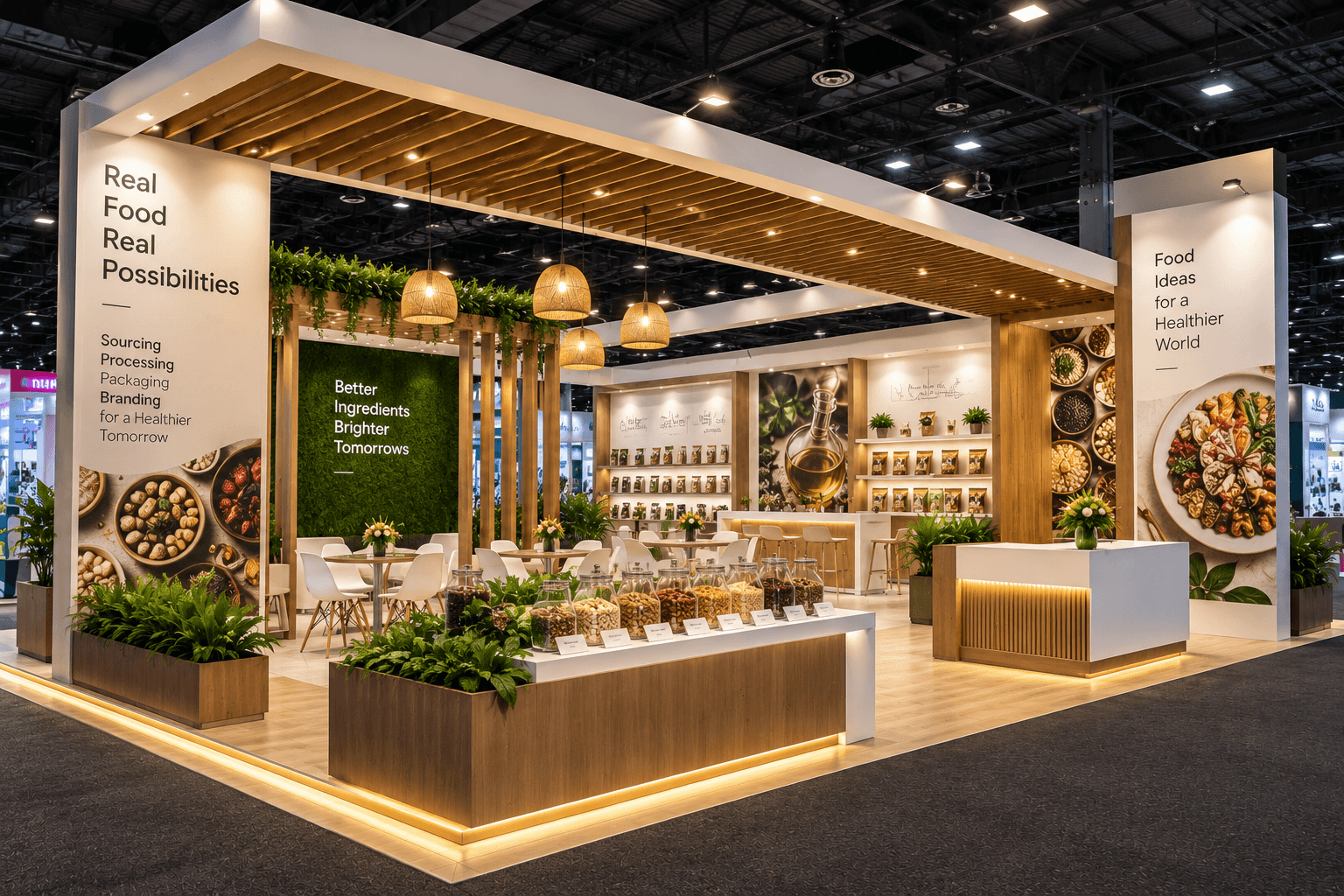
One of the first questions exhibitors naturally ask is: “How much will our exhibition stall cost?” It is a fair question. But stall size alone rarely gives you the answer. A 50 sqm stall designed primarily for product display and meetings can have a very different budget from another 50 sqm stall that requires sampling, refrigeration, multiple product displays, AV, hospitality and significant storage. For an F&B exhibition like Indusfood 2027, I would therefore start the budget conversation differently.
What does the stall need to do — and what will it take to make it completely operational when the exhibition opens? Here are the factors that usually shape that answer.
1. Stall Size Matters — But It Is Only the Starting Point
A larger stall naturally requires more material, flooring, lighting, branding and installation effort. But cost does not increase purely in proportion to area. Two equally sized stalls may have completely different specifications. One may be relatively open with a few product displays and meeting tables. Another may include enclosed storage, sampling counters, refrigeration, suspended elements, AV, premium finishes and multiple meeting areas. So square metres tell us how much space we have. They do not tell us what we are building inside it.
2. The Design Determines the Fabrication
Every line in a render eventually has to become something physical.
- Curved structures.
- Raised platforms.
- Feature ceilings.
- Backlit graphics.
- Custom counters.
- Product displays.
- Storage rooms.
- Meeting spaces.
- Decorative finishes.
The more customised the environment, the more production it usually requires. This does not mean a good stall needs to be complicated. In fact, some of the strongest exhibition spaces are relatively simple. The objective should be to spend where it improves the brand or the visitor experience — not to add fabrication merely because space is available.
3. Materials and Finishes Can Change the Budget Significantly
Two stalls may look similar on screen but use very different materials in production. Flooring is a simple example. So are wall finishes, graphics, counters, furniture and lighting. Premium finishes can create a very different visual experience, but they should be used deliberately. Ask where the visitor will actually notice the difference. A premium material used on an important product display may add value. The same material used somewhere nobody sees may simply add cost. Good budgeting is not about making everything cheaper. It is about knowing where the money matters.
4. F&B Product Display Has Its Own Requirements
At Indusfood, the product is often one of the most important elements of the stall. That may require:
- Shelving.
- Display counters.
- Product pedestals.
- Backlit displays.
- Sample presentation.
- Packaging displays.
- Refrigerated displays.
- Demonstration areas.
Different product categories may also require different presentation environments. These are not decorative additions. They are part of how the brand sells at the exhibition and should therefore be included in the budget from the beginning.
5. Sampling Can Affect More Than the Counter
A sampling counter is easy to draw. The operational requirement behind it is larger.
- Where are samples stored?
- Do they need refrigeration?
- Where are they prepared?
- What equipment is required?
- Where does backup stock sit?
- How is the area replenished?
- Where does waste go?
- Does the activity require additional power or utilities?
- How will the counter be cleaned throughout the day?
That is where some exhibition budgets begin to change after the initial quotation.
6. Refrigeration and Equipment Need to Be Identified Early
For some F&B exhibitors, refrigeration is essential. Others may need preparation equipment, coffee machines, screens or demonstration equipment. These requirements affect more than equipment rental. They can influence:
- Electrical planning.
- Counter dimensions.
- Storage.
- Ventilation.
- Visitor movement.
- Technical services.
- Installation.
If the equipment requirement appears after the design is frozen, the stall may need modification — and modifications usually cost more than planning correctly in the first place.
7. AV and Technology Can Be Simple or Significant
A screen showing a brand film is very different from a large LED installation or interactive product experience. Consider:
- Displays.
- LED walls.
- Audio.
- Laptops.
- Interactive screens.
- Lead-capture systems.
- Internet connectivity.
- Charging.
- Content playback.
Technology should support the exhibition objective. A screen nobody watches is not automatically valuable because it is large.
8. Furniture, Hospitality and Meeting Areas Add Up
- Tables.
- Chairs.
- Sofas.
- Bar stools.
- Reception furniture.
- Meeting-room furniture.
- Pantry equipment.
- Coffee service.
- Hospitality counters.
Individually these may not appear significant. Across a larger stall, they become a meaningful part of the budget. The same principle applies here: Plan around how many conversations the space genuinely needs to support.
9. Logistics Is Part of the Stall Cost
Fabrication happens somewhere. The exhibition happens in Greater Noida. Between those two points are:
- Packing.
- Transport.
- Loading.
- Unloading.
- Material movement.
- Installation.
- Supervision.
- And eventually dismantling and return logistics.
A quotation that excludes some of these costs may initially look attractive but is not necessarily cheaper once the complete exhibition requirement is considered.
10. Venue Services May Sit Outside the Fabrication Quote
Some costs may be charged separately from stall fabrication. Depending on the exhibition and approved venue requirements, these could include services such as power, internet, rigging, material handling or other organiser/venue facilities. The exact requirements should always be checked against the current exhibitor documentation. The important budgeting question is: Which costs are included in the fabricator's quotation, and which will come separately? You want to know that before comparing vendors.
11. Installation Time and Manpower Matter
A complicated stall generally requires more time and manpower to install than a simple one. The execution plan may involve:
- Carpenters.
- Electricians.
- Graphic installers.
- AV technicians.
- Supervisors.
- Helpers.
- Painters or finishing teams.
The objective is not simply to minimise manpower. It is to ensure the right team can complete the approved design properly within the available installation window.
12. Show-Day Support Has a Cost — and a Value
Once the stall is handed over, the exhibition begins. Something may still need attention.
- A graphic gets damaged.
- A light fails.
- A product display needs adjustment.
- Additional branding is required.
- A counter needs repair.
Some exhibitors therefore require on-site or on-call production support during the show. If that support is important, clarify whether it is included or additional.
13. Last-Minute Changes Are Usually the Most Expensive Changes
A change made during design development may require a few minutes on a computer. The same change after fabrication can mean:
- New material.
- New graphics.
- Additional labour.
- Extra transport.
- Overtime.
- Reinstallation.
That is why timely approvals are not merely a project-management issue. They are a cost-control tool.
So How Should You Compare Indusfood Stall Budgets?
I would not begin by comparing:
- Vendor A: ₹X
- Vendor B: ₹Y
- Vendor C: ₹Z
First make sure all three numbers represent approximately the same requirement. Compare:
- Design & fabrication — what exactly is being built?
- Materials & finishes — what quality has been specified?
- Product display — what is included?
- Sampling & refrigeration — included or separate?
- AV & electrical — what has been allowed for?
- Furniture & hospitality — included or excluded?
- Storage — adequate for actual operations?
- Logistics & installation — included?
- Venue services — included, estimated or separate?
- Show-day support — available?
- Dismantling — included?
Only then does comparing the final number become meaningful.
Final Thought
There is no single “correct” budget for an Indusfood stall. There is a correct budget for the stall your business actually needs. A brand focused on meetings and product display may need one kind of environment. A brand running continuous sampling, refrigeration and demonstrations may need another. That is why the most useful question at the beginning is not: “What is your rate per square foot?” It is: “What do we need this stall to achieve, and what is the complete cost of making that happen?” Because a good exhibition budget should not merely get the structure built.
It should get the brand to Indusfood 2027 ready to exhibit, engage and do business.

Gaurav writes about leadership, operational excellence, exhibitions, experiential marketing and event execution through practical observations from the field.
Planning Your Stall Budget for Indusfood 2027?
Share your booth size, floor plan, product requirements and brief with our team.
Discuss Your Indusfood Stall