
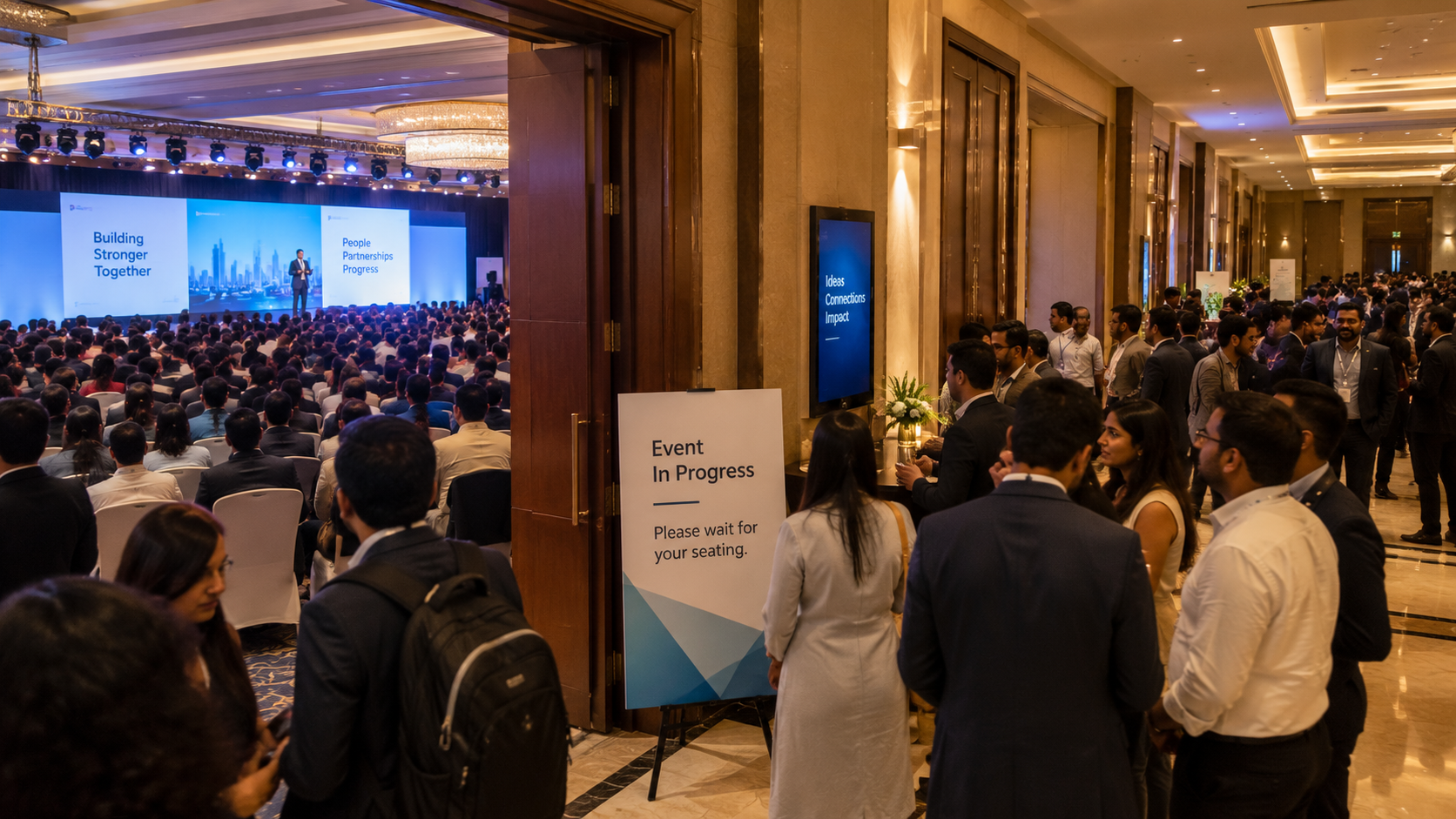
The event had begun. Guests were seated. The programme was underway. The stage was active. Hospitality arrangements were in place. Everything was moving according to plan. Except for one thing. The guests hadn't stopped arriving. We recently faced a situation at a beachfront venue, almost 100 kilometres from the nearest major town. The event was planned for approximately 200 guests. But as the programme continued, more people kept walking in. 200 became 220. Then 250. And eventually, nearly 300.
The hall was already filling up. Seating had been planned for the original guest count. The catering team had prepared accordingly. And there was no nearby city from where additional resources could be arranged immediately. The event couldn't stop. But the plan had to change.
The Challenge Isn't the Extra 100 Guests. It's When They Arrive.
Had we known beforehand that 300 guests were attending, the arrangements would have been different. A larger space. More seating. Additional food. Different service arrangements. But when the event is already underway, those options are limited. You cannot begin moving the stage. You cannot redesign the ballroom. You cannot interrupt the programme every time another group arrives. And you certainly cannot tell guests that the event wasn't planned for them. The real challenge is to adapt the arrangements without disrupting the experience already in progress.
That is a very different kind of event management.
The First Few Minutes Matter Most
When attendance begins exceeding expectations, the instinct can be to react to every new arrival individually. Find another chair. Ask the hotel for more food. Move a table. Call another staff member. But isolated decisions can quickly create confusion. The better approach is to recognise that the situation has changed and establish one coordinated response. Someone needs to monitor arrivals and communicate the revised guest count. Someone needs to work with the venue on available seating and usable space. Someone needs to speak to catering.
And someone needs to ensure the programme continues without unnecessary interruptions. The faster the team moves from individual reactions to one revised plan, the easier the situation becomes to manage.
You Can't Keep Adding Chairs Forever
The first visible pressure is seating. But once the programme has started, rearranging a hall becomes complicated. Guests are watching the stage. Presentations are underway. Service staff are moving around. Every adjustment needs to consider the people already seated. Can existing seating be reorganised without disturbing the programme? Is there an adjoining area that can accommodate additional guests? Can suitable furniture already available at the venue be used? Can guest movement be managed more efficiently?
At a beachfront property, other usable spaces may offer flexibility, depending on the facilities and conditions. The important thing is to make changes thoughtfully rather than keep placing chairs wherever there appears to be room. The goal is not simply to seat more people. It is to preserve the experience for everyone.
Meanwhile, the Kitchen Has Its Own Problem
While the event team is managing seating, another challenge is developing behind the scenes. Food. The caterer has planned for 200. Nearly 300 guests are now attending. And the programme is still running. This is where hospitality planning needs to change quickly. What food is already prepared? What additional ingredients or stock are available? Can certain dishes be replenished more easily? Can the menu be adjusted? Can service counters be reorganised? Can the serving sequence be managed differently? The answer isn't necessarily to prepare 50% more of every dish. That may not be possible.
It is to work with the catering team to understand what can realistically be delivered and how to distribute the available resources effectively. A good catering contingency is not only about additional quantity. It is about flexibility in service.
The Guests Shouldn't Have to Experience the Problem
This is perhaps the most important part. Imagine arriving at an event and seeing the organising team running around, moving furniture, arguing over seating or repeatedly checking whether enough food is available. Even if the event itself is excellent, the experience begins to feel disorganised. Guests should be welcomed, guided and attended to. The additional coordination should happen quietly. The registration team needs clear instructions. The hospitality team needs to know where to direct arrivals. The venue team needs to understand the revised requirements.
The client needs to remain informed without being pulled into every operational decision. And the stage programme needs to continue.
When You're 100 Kilometres Away, You Work With What You Have
A remote beachfront venue can be beautiful. But it changes the nature of last-minute problem-solving. In a major city, you may be able to arrange additional furniture, manpower or supplies relatively quickly. At a remote location, that flexibility is limited. You have to understand what the property already has, what the catering team can manage, which local resources are accessible and how existing arrangements can be adapted. This is where an experienced on-ground team becomes valuable. Not because it has an immediate solution to everything.
But because it knows how to assess available options, prioritise decisions and coordinate multiple teams under pressure. Sometimes event execution is not about getting more resources. It's about making better use of the resources already available.
The Event Doesn't Wait for You to Solve the Problem
While all this is happening, the event continues. The next speaker needs to be introduced. The presentation needs to run. The AV team needs to stay focused. Hospitality must continue. Guests keep arriving. There is no pause button. And that is what makes live event execution so different from planning an event on paper. You are solving one problem while ensuring that ten other things continue to work. The best response is not necessarily the most dramatic one. Often, it is a series of small, coordinated decisions made quickly and quietly.
What This Experience Teaches Us
We spend considerable time planning what an event should look like. The stage. The branding. The agenda. The hospitality. The guest experience. But we also need to plan for the possibility that the actual event will behave differently from the brief. Especially when guest attendance is not tightly controlled. It is worth asking beforehand:
- How will we track arrivals against the expected count?
- What happens if guests continue arriving after the programme begins?
- What seating flexibility does the venue offer?
- What catering alternatives are available?
- Who makes quick decisions without interrupting the event?
- What additional resources are available at a remote location?
These questions may never become relevant. But when they do, the time to think about them has usually already passed.
Final Thought
There is a particular kind of pressure that only people who manage live events truly understand. The programme is running. The client is engaged. Guests are enjoying themselves. And behind the scenes, the numbers are changing faster than the arrangements can keep up. You cannot go back and change the original brief. You cannot stop the clock. You have to make decisions with the people, space and resources available at that moment. That's where planning gives way to experience. Because a good event plan prepares you for what is expected.
A good event team knows what to do when the unexpected walks through the door — and keeps walking in.

Gaurav writes about leadership, operational excellence, exhibitions, experiential marketing and event execution through practical observations from the field.
Planning a Corporate Event?
From venue planning and guest management to hospitality and on-ground coordination, Triangular Dots helps teams manage the moving parts of live events.
Discuss Your Event